
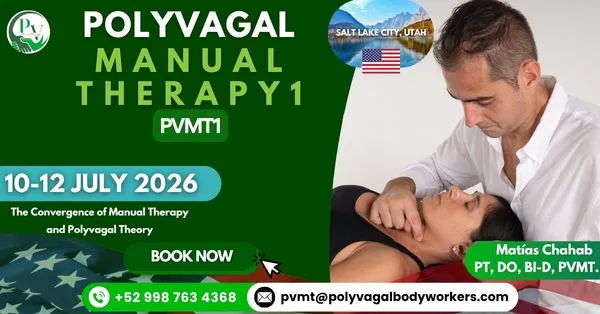
POLYVAGAL MANUAL THERAPY Utah Course in Salt Lake City.
Discover a unique training that will transform your clinical practice. Reserve your spot now!
The Polyvagal Manual Therapy Utah Course in Salt Lake City offers an exceptional opportunity to learn and apply an innovative therapeutic approach that enhances both physical and emotional well-being.
📘 Professor : : Matías Chahab 🇮🇹 DO. BI-D. PVMT.
👥 Who is this for: Manual therapists, osteopaths, physiotherapists, physicians, and professionals interested in integrating Polyvagal Theory into their clinical practice.
📅 Dates: Friday, July 10, Saturday, July 11, and Sunday, July 12, 2026 (3 days)
🕒 Schedule: 9:00 AM – 1:00 PM and 2:30 PM – 5:30 PM
Registration: Day 1 at 8:30 AM
📍 Location: Salt Lake City, Utah, USA
🏫 Format: In-person
📌 Investment & Payment Options: $1,150 US dollars
✉️ Register: pvmt@polyvagalbodyworkers.com
📱 WhatsApp: +52 998 763 4368
🔗 View full module description of the Polyvagal Manual Therapy Course
PVMT1 – Foundations and Initial Application of Polyvagal Manual Therapy
Full Description:
The PVMT1 module establishes the fundamental foundations of Polyvagal Manual Therapy, effectively integrating the principles of Polyvagal Theory with advanced manual techniques. This first level is designed to help participants understand how the autonomic nervous system (ANS) profoundly influences both physical and emotional health. It also explores how proper regulation of the ANS can significantly transform therapeutic practice.
Throughout this module, participants will not only learn to identify the physiological states of the patient, but also to analyze their direct impact on behavior and associated pathologies. To achieve this, the program combines a strong theoretical foundation of the ANS with specifically applied manual practices. These include the treatment of key structures such as the vagus nerve, trigeminal nerve, hypoglossal nerve, and glossopharyngeal nerve, among others.
Additionally, the therapeutic approach includes a detailed exploration of the topographic anatomy of the face and neck. These areas are essential for autonomic regulation and provide direct access points for precise intervention. This allows therapists to work on critical regions that influence ANS modulation.
Beyond anatomical exploration, myofascial and neural techniques are introduced. These tools stand out for their ability to influence both interoception and exteroception—two key processes in physiological self-regulation. Finally, the module emphasizes the importance of integrating theory with practice, ensuring that participants can immediately apply what they have learned in their clinical work.
In summary, PVMT1 is a unique opportunity for professionals seeking to integrate an innovative and highly transformative approach. This module provides practical tools to address autonomic regulation and improve both physical health and emotional well-being in patients.
Main Topics:
- History and principles of Polyvagal Theory
- Anatomy, embryology, and functions of the autonomic nervous system
- Principles of applied myofascial and neural techniques
- Exploration of the topographic anatomy of the face and neck (anterior region)
Nerves and Structures Addressed:
- Vagus nerve (superior and inferior ganglia)
- Superior, inferior, external, and recurrent laryngeal nerves
- Trigeminal nerve and its branches
- Hypoglossal nerve and its connections
- Glossopharyngeal nerve
- Facial nerve
Practical Treatments:
- Specific techniques for facial expression and swallowing muscles
- Treatment of the thyroid cartilage and tracheal rings
- Use of levers (tongue and eyes) as neuromuscular tools
- Practical exercises to stimulate ANS regulation
 _ES
_ES